
[By Sreshta Ladegaam]
Every morning, 22-year-old Nazia Fatima waits for her brothers to head out for work. After making sure they are gone, she sets off to attend her vocational training course. She learns tailoring, hangs out with fellow trainees, and leaves in time to reach home before her brothers. “Mere bhai log ko malum nahin hein hum aarahe bolke (My brothers do not know that I come here),” she says, as we sit in the corner room of the field office of Kriti Social Initiatives. It is a converted residential space, located above a bakery opposite Hafsa Hospital on a narrow but busy street in the Talab Katta neighborhood of the Old City, Hyderabad. As the place bustles with the sounds of stitching machines overlapping with women’s voices, Nazia talks to me about restoring her hopes and dreams.

Nazia stitching
“I wasn’t allowed to study after 10th. But I wanted to make something of myself,” says Nazia, who is a resident of Old City. Through the field coordinator Arif, Nazia discovered Kriti’s ‘Project Milan’, a program that aims to provide vocational training to economically vulnerable women in Hyderabad. She convinced her mother to let her enroll in the program in January 2023. Despite initial resistance, Nazia’s mother is now supportive of her efforts. “I didn’t have a chance to excel at education. This is an opportunity I do not want to let go of,” she says. Nazia is hopeful that soon she’ll be able to start a tailoring business from home and become financially independent.
For the last eight years, Kriti has been uplifting numerous women like Nazia through various projects under their women empowerment program. Limited accessibility, lack of opportunities, and patriarchal family structures have had negative effects on the socio-economic development of women from minority communities in Hyderabad. Over the last three decades, several activists and grassroots NGOs like Kriti have played a vital role in shifting attitudes and creating positive change.
Kriti was established in 2009 with a mission to work with the urban poor, following extensive research conducted in selected parts of the city facing significant socio-economic stresses. Although Kriti’s initial efforts centered primarily around healthcare, they eventually diversified their activities to include early childcare, assistance to the unorganized labor force, and more. With time, Kriti narrowed its scope to two broad areas—enhancing educational opportunities for children, and empowering women through livelihood skills training.
Kriti’s head office is in Shaikpet where most of their work was originally concentrated. They have a variety of initiatives promoting children’s education, such as providing scholarships, collaborating with government schools, and establishing computer centers, primarily in the Shaikpet mandal. The area is one of the oldest suburbs in Hyderabad with a population of over 250,000 including a large number of migrants and informal sector workers. Despite its close proximity to high-income neighborhoods such as Filmnagar, Manikonda, and Gachibowli, Shaikpet has not experienced the same level of socio-economic development.
Nearly a decade ago, Kriti’s Project Milan commenced under the women empowerment domain to equip women with vocational skills and to promote financial autonomy. Beginning with a tailoring course at one location, the project now comprises seven active training centers spread across five neighborhoods in Hyderabad, along with a new avenue of beautician training programs.

Girls in tailoring training at Talabkatta field office
Roshan Begum, who has been the tailoring trainer at Kriti’s Talab Katta field office for two years, shares that she had seen many young girls join the training program under Project Milan to achieve financial stability for themselves and their families. “It’s great working at Kriti,” she says, “I don’t really have anything to complain about. However, one challenging aspect of my job is dealing with women and girls who don’t understand numbering and measurement due to a lack of educational opportunities.” Nonetheless, Roshan notes that they are quick to learn. Most unmarried women and girls manage to complete the course, but married women sometimes face obstacles due to family pressures and the demands of caregiving. This underscores the impact of traditional family structures on women’s access to education and economic opportunities.
During the early stages of Project Milan, trainees raised concerns regarding the lack of work opportunities after the completion of the four-month tailoring program. “So we started the brand Kritikala as a way to give livelihoods to the women who had learned tailoring with us,” says Himani Gupta, co-founder of Kriti. It started with simple products like jute bags and bedspreads that the early trainees could easily make. “It got one big boost in 2017 when we set up the community production center,” says Himani, “then we got industrial machines, we got a larger scale, and we had a senior cutting master who could teach. That’s when we got into garment making.” The product range now includes garments for people of all ages and genders, bags, accessories, home linen, and more. These products are made using local fabrics, specifically the Kalamkari, Ikat, and Mangalagiri cotton fabrics, native to the Telugu states.

Kritikala brand images from Shaikpet
This aspect of Kriti’s work that directly provides livelihoods linkage to women is ‘Project Hunar’. Kriti’s Tolichowki production unit under Project Hunar was established through a partnership between the Telangana State Minority Finance Corporation and the Bashir & Sarwar Babu Khan Trust. The vision behind this community production center was to create work opportunities specifically for women from minority communities. This unit is located above the Denti Citi Clinic in Balreddy Nagar and spans two floors. The shop is equipped with industrial-grade stitching machines for garment and accessory production. It also houses a beautician training program under Project Milan.
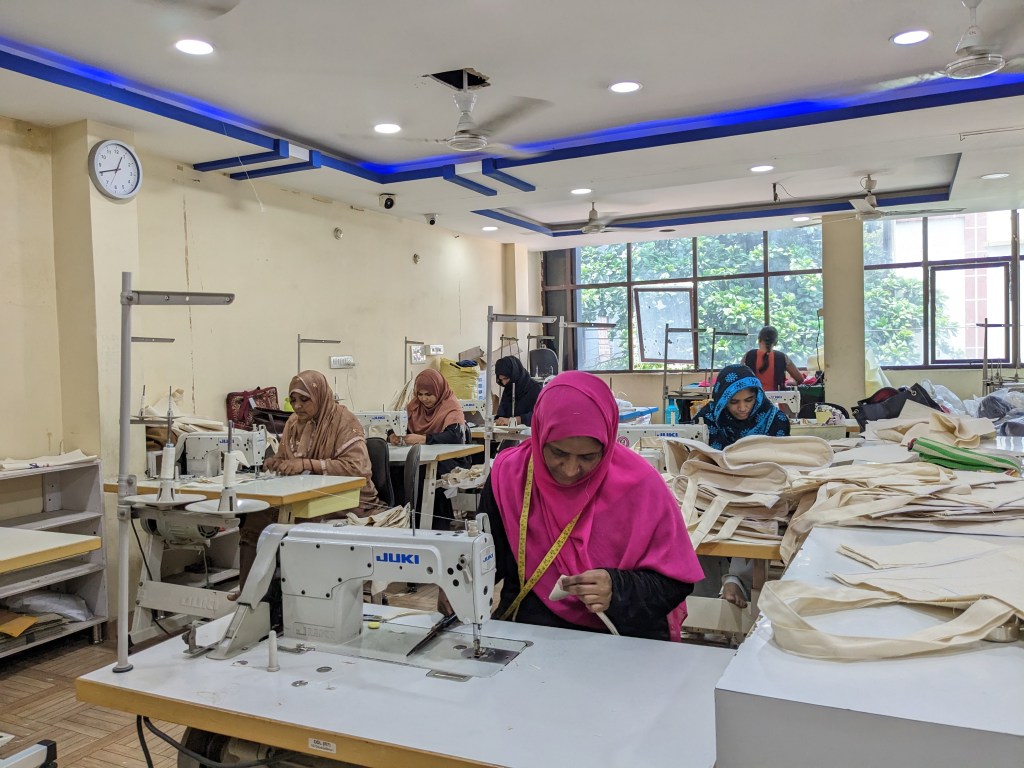
Women stitching bags and clothes at Tolichowki
Women working and training at Kriti are united by a shared aspiration for self-sufficiency and securing the future of the next generation. They credit the environment at Kriti that fosters a sense of community for inspiring its members to take tough decisions and challenge societal norms at home. Nafees Fatima, who started working at Kriti’s production unit a year ago, talks about the challenges brought on by the COVID-19 pandemic, as her husband lost his job. “Mujhe apni alag pehchaan banaani hein (I want to establish my own identity),” Nafees says, as she recalls her experiences of abuse and separation from her in-laws. She firmly believes that both she and her husband should work together to secure a bright future for their children. Women employed with Kriti during the COVID-19 pandemic reported receiving exceptional support, including regular salaries and essential ration supplies.
The COVID-19 pandemic also brought about some significant changes in the functioning of Kriti as an NGO and Kritikala as a brand. Kriti engaged in community relief activities by supplying rations, raising funds, running a helpline, and conducting awareness programs on managing COVID-19 infections at home. Training modules were fully redesigned to include both online and offline aspects. There was a drop in the number of women enrolling but the numbers went back up after the lockdowns were lifted. As exhibitions and offline sales were challenging to execute, the focus shifted to online sales. Kritikala now has a fully functioning online store for all its products.
Kriti’s most recent project under the women empowerment domain is ‘Project Pehchaan’. With Milan, unskilled women who aren’t economically active get to learn a technical skill in the hope that it may provide some supplementary income. However, there are already several women who are economically active but work from their home and fall under the informal sector. “They are typically under-represented, exploited, and they do not even consider themselves economic agents even though they are working hard and earning an income,” says Himani Gupta. Kriti identified clusters of women who do artisanal activities like lac bangle making, paper flower making, tailoring, agarbatti rolling, safety pin making, and garlic peeling from their homes. The main objective of Project Pehchaan is to form a collective of home-based artisans in Hyderabad.
“We have chosen the platform of Self-Help Group (SHG) formation under the Project Pehchaan,” explains Himani Gupta, “It is a pretty resource-intensive platform but it’s also a powerful platform because it allows us to build community leadership and develop essential skills among women.” SHGs have been a widely adopted approach by governments, non-profits, and other donors in India to facilitate credit access for women so they could either meet their basic needs or invest in income-generating activities. By doing so, the programs aim to improve the economic situation of these women and help them become more self-sufficient. When a self-help group is formed, the members elect leaders who take on ownership and responsibility for managing the group’s proceedings, including cash transactions. This process helps women develop leadership skills, learn financial management, and take ownership of their group’s activities.
Project Pehchaan’s activities are concentrated in the areas of Talab Katta and Yakutpura. Arif-ul-Islam, the field coordinator, says, “The aim is to help the women to rise above the poverty line and achieve independence.” Field officers conduct door-to-door campaigning to spread awareness regarding the SHG formation. They also run the SHG meetings and take care of book-keeping initially, while simultaneously building leadership skills among women. In the third month, a bank account with the name of the SHG is created. Currently, there are 18 active SHGs in the area, composed of home-based artisans and homemakers. “The idea is that through a continuous process of training and financial linkage, we will see some change in their mindset and ability to step out of their homes, visit the bank, and take charge of their money themselves,” says Himani Gupta.
Kriti also supports the lac bangle artisans by helping them with design and marketing linkages. The process of lac bangle making includes a huge network of people from karkhanas and raw material sellers to home-based women artisans who embellish the lacquered bangles with stones according to a preferred design. Women usually learn this skill through neighbors, friends, and relatives.
Amreen Begum, a member of the SHG Gulshan, has been making lac bangles for four years. However, due to the birth of her third child 10 months ago, she had to take a break from this work. Currently, Amreen is taking up tailoring gigs from home but wishes to return to making lac bangles once her youngest daughter starts attending school. Three months ago, Amreen found out about Kriti through an acquaintance and has been actively involved with the SHG Gulshan ever since. She states that her priority is to provide her three daughters with education in private schools and believes that she can save up with the help of the SHG.
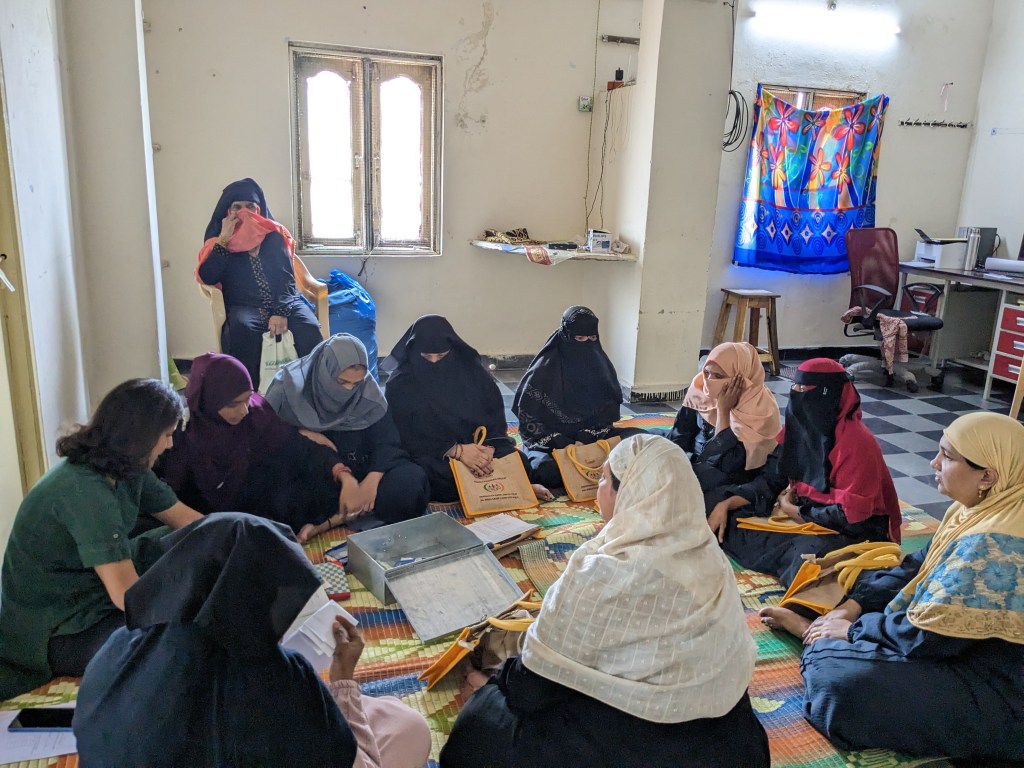
SHG meeting with Women Empowerment project coordinator Ranjana
Project Pehchaan has presented some challenges in terms of organizing and motivating women to take initiative, participate in meetings, and assume leadership roles, largely due to existing social conditioning and cultural norms. But Himani believes that it still opens up a lot of avenues. As Kriti looks towards the future, they are exploring ways to expand Project Pehchaan’s reach and make a positive impact on the community through health education and livelihood linkages for women. Similarly, for Project Milan, the aim is to stabilize the beautician training program and bring it to the same level of success as the tailoring training.
Project Hunar continues to employ women like Syeda Unnisa who has been working at the Tolichowki production unit for five years. “Mujhe toh bas mere bachon ko settle karna hein (My main goal is to support my children to settle down),” she says. To pay for her children’s school tuition, she turned to tailoring professionally and aspires to send her eldest son to Australia for higher education.
Despite facing new challenges and needs as they build a network of women, Himani remains hopeful that the team at Kriti can address these issues. They are actively seeking opportunities and partnerships to expand their operations, with the goal of making a meaningful impact on the lives of marginalized women in Hyderabad.
 FEMLAB